

Lebanon · 5 min read
How do I run my whole business from one website in Lebanon?
The short answer
Use one website whose dashboard takes the bookings and orders, keeps a record of each customer, handles Whish, OMT, bank transfer or cash on delivery, and holds the history, instead of a site, a booking app, a spreadsheet and WhatsApp. Move the part that costs you most first, and keep WhatsApp for the conversation.
On this page
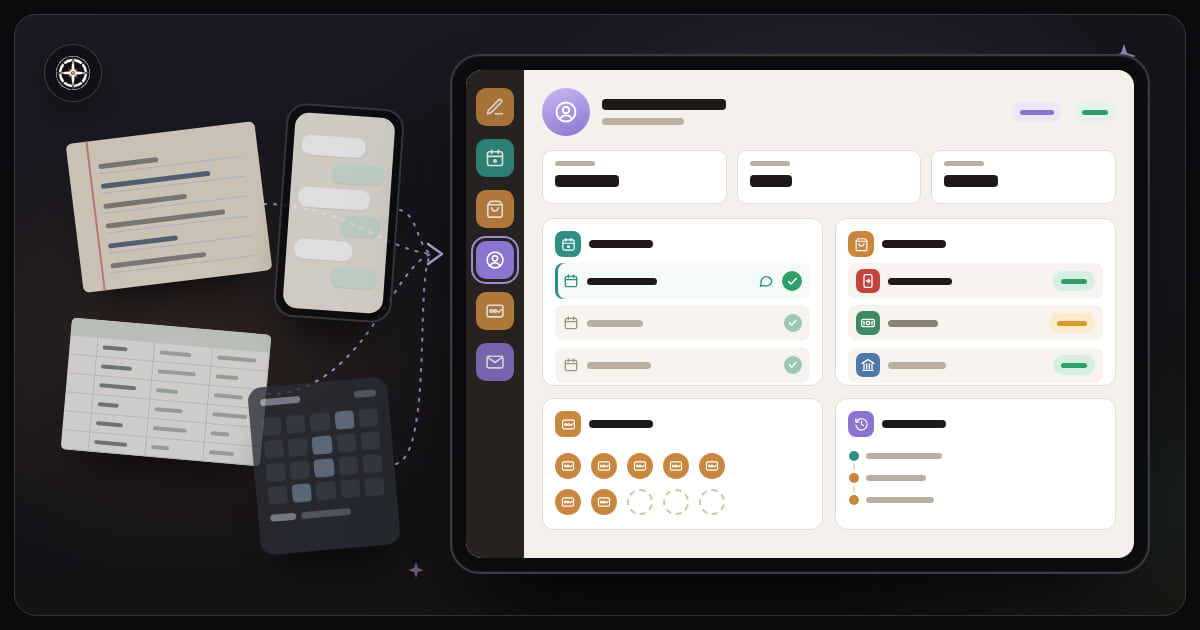
Ask a small business here what it runs on and the answer is usually a list. A website somebody built two years ago. WhatsApp for enquiries. A notebook or a spreadsheet for regulars. Maybe a booking app that charges commission.
None of them talk to each other, so you are the integration. Every booking gets read in one place and written in another.
That is the real cost, and it does not appear on any invoice.
What most businesses here actually run on
The website is a brochure nobody updates. The trade happens in messages. The customer history lives in one person's head, and when that person is away, it is gone.
It works until volume breaks it: the day the messages take longer than the work, or the day two people answer and one double-books.
The cost of the gaps between tools
Three things leak in the gaps, and none of them are obvious month to month.
Information gets retyped, and retyping is where mistakes live. A transposed digit in a phone number is a lost customer who thinks you ignored them.
History disappears. If a regular's last four visits are in a chat thread, you cannot answer "when were they last in" without scrolling.
And nobody can cover for you. A business that only works while one person holds it in their head is fragile, and no software caused that.
What "one place" has to include
Four things, and a setup that misses one of them has not solved the problem. On Helm, each is a tool in the same dashboard as your website.
It takes the request on your own site. On your domain, not on a marketplace and not only in a message thread. Bookings, on the Standard and Business plans, gives you a request inbox: the customer asks for a day, and you confirm or decline it from your dashboard. The Shop, on the same two plans, takes orders from a catalogue with stock counted per variant. Plain enquiries come through forms, which are on every plan. Adding bookings to the site you already have does not mean rebuilding it.
It knows who the request came from. Customers gives each person one page: their orders and saved addresses, their bookings and their loyalty card. With it switched on, a booking is filed under the person by their email, even if they never made a login. It comes with customer accounts, which are included on the Standard and Business plans.
It handles the money the way money moves here. Whish, OMT, bank transfer and cash on delivery are not edge cases in this market. The Shop lets you offer all four, and it does not take cards. The buyer types the transfer reference at checkout and you confirm it against your own statement before dispatch. Running an online store without card payments walks through that sequence.
It keeps the history. With the request and the person in one place, the record outlives whoever took the booking. A loyalty card, one of the 3 tools you choose on Standard and included on Business, sits on the same page if you want regulars to have a reason to come back.
The Lebanon-specific parts
Two things are different here, and advice written elsewhere misses both.
The first is language. If people message you in Arabic, the reply should be in Arabic. Not because it is polite, but because a reply in the wrong language is a small signal that you were not really set up for them. On Helm, the email confirming or declining a booking goes out in the language of the page it was made from. An Arabic half that mirrors properly is what makes that page exist.
The second is that the phone is the channel. WhatsApp is where this trade happens, and a system that fights that loses. The point is not to replace the conversation. A booking request on Helm carries the customer's WhatsApp number, and tapping it opens the chat, so you still reply where they expect you. What changes is that the booking ends up somewhere you can find it next month. Taking orders on WhatsApp without losing them is the same idea for orders.
What to move first
Not everything, and not the website.
Move the thing that costs you most when it goes wrong. For a salon or a clinic that is bookings, and taking them on your own site rather than a commission marketplace is usually the first thing that pays for itself.
For a shop it is orders and the payment method. For a service business it is enquiries, because an enquiry that falls through a gap is money you never knew you lost.
Do one. Let it run for a month. Then decide whether the next one is worth it. The customer record is usually the second move, once you want to see everything by person.
When keeping them separate is fine
If your volume is genuinely low, four tools and a notebook are cheaper than any platform, and anyone telling you otherwise is selling something.
If your system works and everyone knows it, changing it has a real cost that rarely gets counted.
And if the thing holding your business back is that nobody has heard of you, software is not the answer. The free things that compound are, and they come first.
The short version
One place is worth it when the gaps between your tools start costing more than the tools do. That threshold arrives with volume, and it arrives quietly.
The test is simple: if a regular walked in tomorrow and asked what they had last time, how long would it take you to find out? If the answer is "scroll back through WhatsApp", you already know. And whether your domain should be .com.lb or .com matters a great deal less than that.