

Bookings · 5 min read
How do I stop people not turning up?
The short answer
Confirm the day before, in the place they actually read. Most no-shows are not people changing their mind — they are people who forgot, or who were never sure the booking existed. A short message the day before fixes more of it than any policy, and you only need three things to send one: what is due tomorrow, who it belongs to, and how to reach them.
On this page
A no-show costs you the slot, the preparation and sometimes the stock. For a salon chair or a table on a Friday night it is the difference between a good week and an average one, and it is the complaint I hear most from businesses that have just started taking bookings online.
The instinct is to reach for a penalty. That is usually the wrong first move, because it treats a memory problem as a behaviour problem.
Most no-shows are not decisions
Ask the people who did not turn up and the answers cluster: they forgot, the date moved in their head, they were not sure the booking had gone through, or they meant to cancel and felt awkward about it.
Almost none of that is somebody deciding your time is worthless. It is a booking made two weeks ago that stopped being real to them.
That matters because the fix for forgetting is a reminder, and the fix for awkwardness is an easy way out. Neither is a penalty, and reaching for the penalty first tends to punish your best customers for the behaviour of your worst.
The message that prevents most of it
One short message the day before. Not a marketing message, not a survey — a confirmation with an exit.
Hi Dana — just confirming tomorrow at 4pm. Reply here if you need to move it, no problem at all.
Three things make it work. It arrives the day before, when the person can still act on it. It states the actual time, which catches the ones who had it wrong. And it offers the exit out loud — no problem at all — because the awkward cancellations are the ones that become no-shows.
Send it where they will see it. For a lot of businesses here that is WhatsApp, not email, and a message that gets read is worth more than a message that is well designed. If they wrote to you in Arabic, confirm in Arabic — that is the half most setups get wrong.
What you need in order to send it
This is the unglamorous part, and it is the whole thing. To send that message you need to answer three questions every morning:
- What is due tomorrow? Not this week. Tomorrow, in a list.
- Who is it? A name attached to that slot.
- How do I reach them? A number or an address you already have, without hunting.
If any of the three takes you more than a minute, the message will not get sent on a busy day — which is exactly the day you most need it.
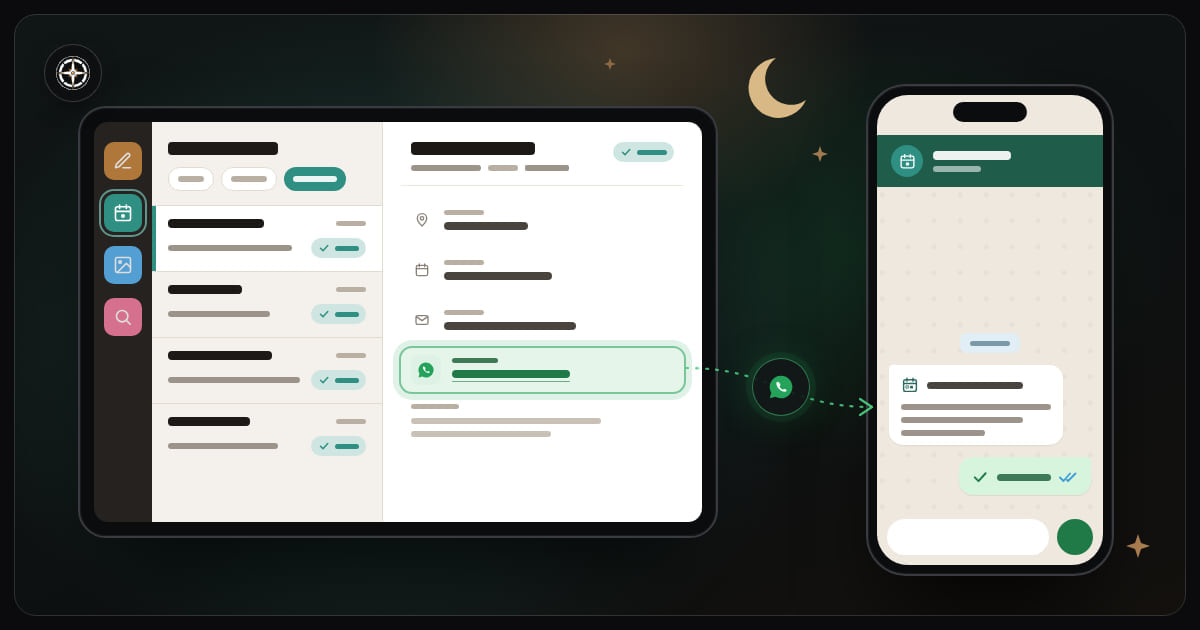
On Helm's Standard and Business plans, where Bookings is one of the tools, a booking request arrives carrying the person's name, their email, their WhatsApp number if they left one, the date they asked for and whatever they typed, and it sits in one list in your dashboard that you can filter to pending, confirmed or declined. So the morning question — what is due tomorrow and how do I reach those people — is a scan down your confirmed bookings rather than a search through your messages.
The WhatsApp number is the part that matters here. The message that works is the personal one above, from you, where they actually read, and with the number already on the booking, one tap from the chat, it takes two minutes rather than a hunt. When you confirm or decline a booking, the email that goes back is in the language of the page they booked from — English, French or Arabic — so someone who booked in Arabic hears back in Arabic.
Confirm at the moment of booking, too
The second-biggest cause is doubt that the booking exists at all. Somebody fills in a form, sees nothing back, and quietly assumes it did not work — so they either book elsewhere or turn up unsure.
A quick confirmation with the date in it removes that entirely. It is the single cheapest change on this list: one short reply per booking, and the sooner it goes, the less room there is for doubt.
With Bookings on Helm's Standard and Business plans, you get an email the moment a request lands, with the person's details in it, so you can confirm it within minutes. Your confirmation reaches them under your business's name, with the date they asked for and a booking reference they can quote if they write back.
Then, and only then, think about deposits
If you still have a no-show problem after confirming at booking and again the day before, you have a different problem, and now a deposit is a reasonable answer.
A few things worth knowing before you add one. A deposit will reduce bookings as well as no-shows — that is the trade, and for a new business it can cost more than it saves. It works far better for high-value, low-volume slots than for a fifteen-minute appointment — a barber's fifteen minutes and a venue's evening are different problems. And it needs to be genuinely easy to pay, or it becomes a second reason people drift away.
We wrote about taking payments here in practice, which is the harder half of that decision.
The ones who are genuinely wasting your time
There is a small group who book repeatedly and never arrive. Policies will not reach them, because they were never confused.
The answer is a note against the name and a judgement, not a rule applied to everybody. Most systems, including a notebook, will let you do this. The mistake is writing a policy for your whole customer base to handle four people a year.
The test
Tomorrow morning, try to answer this in under a minute: who is coming today and tomorrow, and how do I message them?
If you can, you already have everything a no-show policy would have given you, and you can start sending the message this week. If you cannot, that is the thing to fix first — a booking system's real job is answering that question, and everything else it does is secondary.